
Choosing a Variant
Add this test by choosing the English Communication test type in the assessment builder, then Add on either card, picking a level first for Fixed-Duration. It is standardized content: you cannot handpick the questions, Equip randomizes them per candidate, and each question carries its own fixed time limit.
The Four Skills
The test evaluates the four core communication skills, Reading, Writing, Speaking, and Listening, through scenario-based questions. Every set contains 2 MCQs each on Grammar and Vocabulary, 1 Reading Comprehension, 1 Listening Comprehension, 1 Speaking Exercise, and 1 Writing Exercise, so the candidate’s report shows six individual skill scores.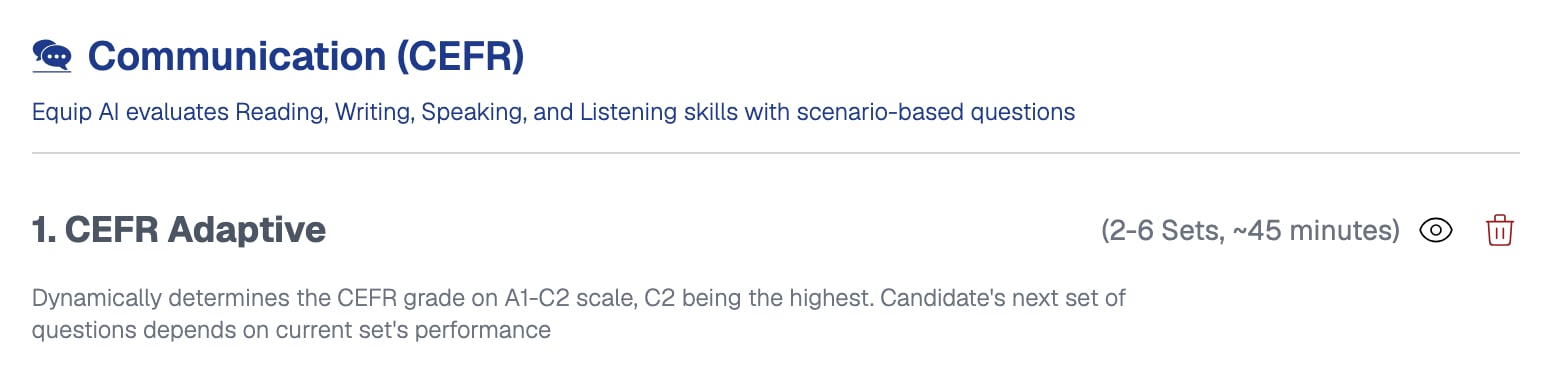
The Communication (CEFR) test in the builder, here in its adaptive form
How the Fixed-Duration Test Works
The recruiter picks a CEFR level when adding the test, and the candidate is scored directly against it.1
Choose a level
Pick the CEFR level to test against, from A1 (Beginner) to C2 (Near-Native), when adding the test.
2
Candidate answers one set
The candidate attempts a single set of questions at the chosen level.
3
AI scores the set
Equip’s AI grades the responses directly, there is no self-assessment or level adjustment.
How the Adaptive Test Works
Instead of giving every candidate the same fixed paper, the test adjusts its difficulty as the candidate answers.1
Candidate self-assesses
Before starting, the candidate rates their own English ability. Based on this, the test begins at A1, B1, or C1.
2
Candidate answers a question set
Each set covers Grammar, Vocabulary, Reading, and Writing, with Listening and Speaking appearing in alternate sets.
3
Difficulty adjusts
A strong set makes the next one a level harder, a weak set makes it a level easier, and a reasonable set keeps the same level.
4
The test ends
The test ends once the candidate has stayed on the same level for more than 2 sets, or after a maximum of 6 sets. Most candidates finish in 4 to 6 sets.
CEFR Levels
Results are reported on the standard CEFR scale.Related Resources
- CEFR Scores - How overall and per-skill CEFR grades are calculated
- Test Types - All test types you can add to an assessment
- Create an Assessment - Add the Communication Test to a role’s assessment
- Psychometric Tests - Equip’s other standardized test type